
- Given a binary tree, print binary tree in vertical order using recursive algorithm.
- Traverse binary tree vertically using depth first search (dfs) algorithm.
- The nodes, which are at same vertical distance, are said to be on same vertical path.
- The root node is assumed to be at vertical distance of 0.
- When, we traverse left subtree, we decrements the distance by 1.
- When, we traverse right subtree, we increment the distance by 1.
- The application of vertical order traversal is Find a vertical order sum in a Binary Tree
Example 1: find vertical distance of nodes in binary tree using java

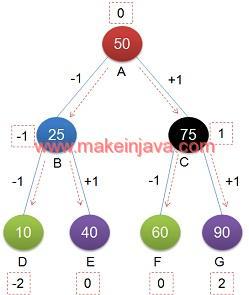
- Root node A is at distance 0
- Node B is left child of node A
- Distance of B Node is decremented by 1.
- Node B is at vertical distance -1
- Distance of B Node is decremented by 1.
- Node C is right child of node A
- Distance of C Node is incremented by 1, (0 + 1) so it becomes 1
- Node C is at vertical distance 1
- Distance of C Node is incremented by 1, (0 + 1) so it becomes 1
Example 2: Vertical order distance of binary tree in java
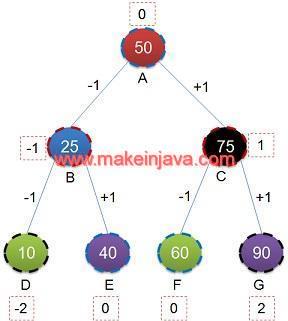
- Node A is at distance 0
- Node B is left child of Node A
- Node B is at vertical distance -1
- Node D is left child of Node B (Node B is at distance -1)
- Node D is at vertical distance -2
- Node E is right child of Node B (Node B is at distance -1)
- Node E is at vertical distance 0 (-1 + 1 = 0)
- Node C is right child of Node A (at vertical distance 0)
- Vertical distance of Node C is 1
- Vertical distance of Node F is 0
- Vertical distance of Node G is 2
Algorithm to find vertical distance in a binary tree using java
- Initialize the distance 0 for root node
- Create a HashMap of Vertical distance and List of nodes
- Map<Integer, List<Integer>> mapVerticalDistance
- Perform the pre order traversal of binary tree
- If, hashmap does not contains distance
- Add distance and node value to hashmap
- else, update for hashmap for corresponding distance
- Perform traversal for left child of
- Decrements the distance by -1 & traverse binary tree
- Perform traversal for right child of
- Increment the distance by 1 & traverse binary tree.
- If, hashmap does not contains distance
- At end of recursive operation, we would get vertical distance of all nodes.
Time complexity of algorithm is O(n).
Program – Vertical order traversal of a binary tree (recursive) using java
1.) VerticalOrderOfBTree class:
- VerticalOrderOfBTree class is responsible, for printing the binary tree in vertical order.
package org.learn.Question;

import java.util.ArrayList;
import java.util.HashMap;
import java.util.List;
import java.util.Map;

public class VerticalOrderOfBTree {
	private static Map<Integer, List<Integer>> mapVerticalDistance = null;

	private static void verticalOrder(Node root, int distance) {
		if (null == root)
			return;

		List<Integer> list = null;
		if (mapVerticalDistance.containsKey(distance)) {
			list = mapVerticalDistance.get(distance);
		} else {
			list = new ArrayList<Integer>();
		}

		list.add(root.data);
		mapVerticalDistance.put(distance, list);
		verticalOrder(root.left, distance - 1);
		verticalOrder(root.right, distance + 1);
	}

	public static void verticalOrderOfBTree(Node root) {

		if (null == mapVerticalDistance) {
			mapVerticalDistance = new HashMap<Integer, List<Integer>>();
		} else {
			mapVerticalDistance.clear();
		}

		verticalOrder(root, 0);
		mapVerticalDistance
				.forEach(
						(k, v)
							-> System.out.println("Nodes at distance " + k + " = " + v));
	}
}
2.) Node Class:
- Node class is representing the nodes of a binary tree.
package org.learn.Question;

public class Node {
	public int data;
	public Node left;
	public Node right;

	public Node(int num) {
		this.data = num;
		this.left = null;
		this.right = null;
	}

	public Node() {
		this.left = null;
		this.right = null;
	}

	public static Node createNode(int number) {
		return new Node(number);
	}
}
3.) App Class:
- We are constructing the binary tree in main method.
- We are calling VerticalOrderOfBTree class to print binary tree in vertical order.
package org.learn.Client;

import org.learn.Question.Node;
import org.learn.Question.VerticalOrderOfBTree;

public class App {
	public static void main(String[] args) {
		// root level 0
		Node A = Node.createNode(50);
		// Level 1
		Node B = Node.createNode(25);
		Node C = Node.createNode(75);
		// Level 2
		Node D = Node.createNode(10);
		Node E = Node.createNode(40);
		Node F = Node.createNode(60);
		Node G = Node.createNode(90);

		// connect Level 0 and 1
		A.left = B;
		A.right = C;
		// connect level 1 and level 2
		B.left = D;
		B.right = E;
		C.left = F;
		C.right = G;

		VerticalOrderOfBTree.verticalOrderOfBTree(A);
	}
}
Output – vertical order traversal of binary tree using java
Nodes at distance 0 = [50, 40, 60]
Nodes at distance -1 = [25]
Nodes at distance -2 = [10]
Nodes at distance 1 = [75]
Nodes at distance 2 = [90]
Download Code – print binary tree in Vertical Order (DFS)