

- Given a binary search tree, Print keys of BST in a given input range k1 & k2.
- We will use depth first search DFS recursive binary tree traversal algorithm.
- Suppose, We are given input range of K1 and K2.
- Print all keys of BST in range of K1 and k2 i.e. key >= k1 & key <= k2)
Example – print binary search tree for given range K1 & K2 in java
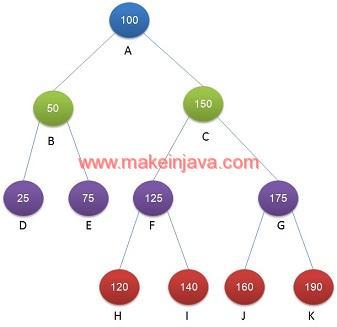
- Suppose input range is K1 = 10 and K2 = 60 for BST
- We should get the output keys: 25 50
- If input range is K1 = 50 and K2 = 125 for BST
- We should get the output keys: 100 50 75 125 120
- At every node, we print the keys which are within input range of K1 and K2.
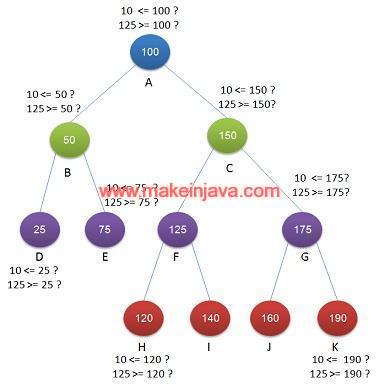
Algorithm – print binary search tree in range K1=10 & K2=125 using java
In Fig 2, we have shown evaluation condition on few nodes.
- Pre order tree traversal, starting from A node (root)
- Check the current node within range of K1 and K2
- root.data >= 10 && root.data <= 125 ?
- if yes, print the data
- root.data >= 10 && root.data <= 125 ?
- Traverse to left sub tree
- Traverse to left subtree if current node is greater than 10
- root.data > 10 ?
- if yes, go to left sub tree
- Traverse to right sub tree
- Traverse to right sub tree if current node is less than 125
- root.data < 125 ?
- if yes, go to right sub tree
- At last, we will able to print the data of binary tree, in given range of K1 and K2
- Time Complexity : O(n)
Program – Print binary search tree (BST) in range of K1 & K2 using java
1.) PrintInRangeBST Class:
- Perform the pre order traversal of BST
- Print the BST in a given range (K1 and K2)
package org.learn.Question;

import org.learn.PrepareTree.Node;

public class PrintInRangeBST {
	public static void printRange(Node root, int k1, int k2) {
		if (root == null)
			return;
		if (root.data >= k1 && root.data <= k2)
			System.out.printf("%d ", root.data);
		if (root.data > k1)
			printRange(root.left, k1, k2);
		if (root.data < k2)
			printRange(root.right, k1, k2);
	}
}
2.) Node Class:
- Node class representing the node of a binary search tree.
package org.learn.PrepareTree;

public class Node {
	public int data;
	public Node left;
	public Node right;

	public Node(int num) {
		this.data = num;
		this.left = null;
		this.right = null;
	}

	public Node() {
		this.left = null;
		this.right = null;
	}
	public static Node createNode(int number) {
		return new Node(number);
	}
}
3.) App Class:
- We are creating the binary search tree in main method.
- We are calling PrintInRangeBST class, to print the binary search tree within a range (K1 and K2) using DFS recursive algorithm.
package org.learn.Client;

import org.learn.PrepareTree.Node;
import org.learn.Question.PrintInRangeBST;

public class App
{
    public static void main( String[] args )
    {
       //root level 0
       Node A = Node.createNode(100);
       //Level 1
       Node B = Node.createNode(50);
       Node C = Node.createNode(150);
       //Level 2
       Node D = Node.createNode(25);
       Node E = Node.createNode(75);
       Node F = Node.createNode(125);
       Node G = Node.createNode(175);
       //Level 3
       Node H = Node.createNode(120);
       Node I = Node.createNode(140);
       Node J = Node.createNode(160);
       Node K = Node.createNode(190);

       //connect Level 0 and 1
       A.left = B;
       A.right = C;
       //connect level 1 and level 2
       B.left = D;
       B.right = E;
       C.left = F;
       C.right = G;
       //Connect level 2 and level 3
       F.left = H;
       F.right = I;
       G.left = J;
       G.right = K;

       int K1 = 10;
       int K2 = 125;
       System.out.printf("Printing binary tree in range %d and %d\n",K1, K2);
       PrintInRangeBST.printRange(A, K1, K2);
    }
}
Output – print binary search tree (BST) in range of K1 & K2 using java
Printing binary tree in range 10 and 125
100 50 25 75 125 120