

- Lowest or least common ancestor (LCA) of two nodes node1 and node2 in a binary tree is:
- The lowest node in a binary tree that has both node1 and node2 as descendant nodes.
- One node can be descendant of another node
- If node2 is descendant node of node1, node1 will be LCA of node1 and node2.
- We are assuming both nodes exists in a binary search tree.
- We will use depth first traversal to find LCA in a binary search tree.
- We have already discussed finding lowest or least common ancestor in a binary tree
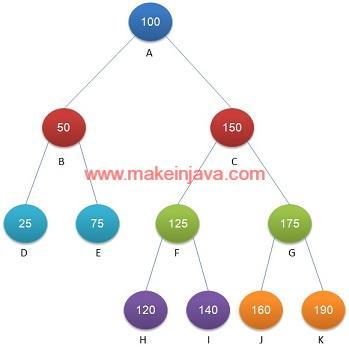
Examples to find LCA of input nodes:
LCA of input nodes using recursive algorithm is as follows:
| S. No | Input nodes | LCA |
|---|---|---|
| 1 | F & G | C |
| 2 | C & G | C |
| 3 | D & E | B |
| 4 | D & B | B |
| 5 | D & C | A |
| 6 | E & G | A |
Example 1: find LCA of Node J & Node K in a binary search tree (java)
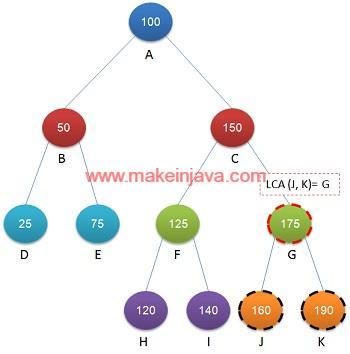
- Find LCA (J,K) is Node G.
- The value at node G is lying within the value of node J and node K.
- Node K > Node G > Node J (assuming unique values in BST).
- There is no other node in a BST, which is having value lying within node J and K.
Example 2: find LCA of node E & node G in BST using java
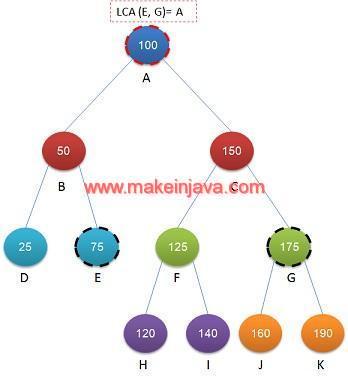
- Find LCA (E, G) is Node A.
- The value at node A is lying within the value of node E and node G (similar to example 1).
Example 3: find LCA of node G and node J in BST using java
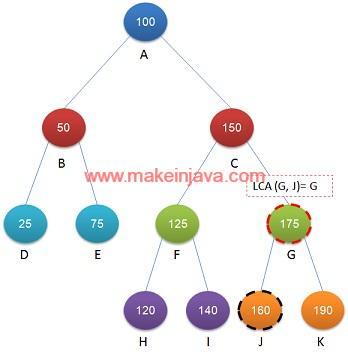
- Find LCA (G, J) is Node G.
- Node J is descendant node of Node G and hence Node G is LCA.
- The ancestor (Node G) has value equals to one of node (node to be searched).
Conclusion: LCA node will have value within (or equal to any node) range of input nodes
Algorithm: find LCA(J,K) in binary search tree using java
- Node A, Node J and Node K input for our function
- Check value of node A is greater than J and K
- 100 > 160 && 100 > 190? No, its not true
- Check value of node A is less than J and K
- 100 < 160 && 100 < 190 ? yes, its true
- LCA of 160 and 190 is in right subtree.
- Go to right child of A i.e. Node C
- Node C, Node J and Node K input for recursive function
- Check value of node C is greater than J and K
- 150 > 160 && 150 > 190? , No, its not true
- Check value of node C is less than J and K
- 150 < 160 && 150 < 190?, yes its true
- LCA of 160 and 190 is in right subtree.
- Go to right child of C i.e. Node G
- Node G, Node J and Node K input for recursive function
- Check value of node G is greater than J and K
- 175 > 160 && 175 > 190?, No its not true
- Check value of node C is less than J and K
- 175 < 160 && 175 < 190? , No its not true
- Then its must be within 160 and 190 [implicit condition]
- return LCA Node G from here
- Check value of node G is greater than J and K
- return Node G
- Check value of node C is greater than J and K
- return Node G
- return Node G
LCA (J, K ) = Node G,
Program: find least common ancestor in BST using recursive algorithm
1.) LCA Class:
- LCA class is used to find the least or lowest ancestor of two input nodes.
- Traverse the binary search tree using recursive algorithm.
package org.learn.Question;

import org.learn.PrepareTree.Node;

public class LCA {
	public static Node lca(Node root, Node A, Node B) {
		if (null == root) {
			return root;
		}

		if (root.data > A.data && root.data > B.data) {
			return lca(root.left, A, B);
		}

		if (root.data < A.data && root.data < B.data) {
			return lca(root.right, A, B);
		}

		return root;
	}
}
2.) Node Class :
- Node class representing the node of binary search tree.
package org.learn.PrepareTree;

public class Node {
	public int data;
	public Node left;
	public Node right;

	public Node(int num) {
		this.data = num;
		this.left = null;
		this.right = null;
	}

	public Node() {
		this.left = null;
		this.right = null;
	}
	public static Node createNode(int number) {
		return new Node(number);
	}
}
3.) App:
- We are constructing the binary search tree in main method.
- We are calling the method LCA class, to find the lca of two input nodes.
package org.learn.Client;

import org.learn.PrepareTree.Node;
import org.learn.Question.LCA;

public class App
{
    public static void main( String[] args )
    {
       //root level 0
       Node A = Node.createNode(100);
       //Level 1
       Node B = Node.createNode(50);
       Node C = Node.createNode(150);
       //Level 2
       Node D = Node.createNode(25);
       Node E = Node.createNode(75);
       Node F = Node.createNode(125);
       Node G = Node.createNode(175);
       //Level 3
       Node H = Node.createNode(120);
       Node I = Node.createNode(140);
       Node J = Node.createNode(160);
       Node K = Node.createNode(190);

       //connect Level 0 and 1
       A.left = B;
       A.right = C;
       //connect level 1 and level 2
       B.left = D;
       B.right = E;
       C.left = F;
       C.right = G;
       //Connect level 2 and level 3
       F.left = H;
       F.right = I;
       G.left = J;
       G.right = K;

       Node ancestor = LCA.lca(A, J, K);
       System.out.printf("Ancestor of %d and %d is %dn",J.data,K.data,ancestor.data);

       ancestor = LCA.lca(A, J, G);
       System.out.printf("Ancestor of %d and %d is %dn",J.data,G.data,ancestor.data);

       ancestor = LCA.lca(A, E, G);
       System.out.printf("Ancestor of %d and %d is %dn",E.data,G.data,ancestor.data);
    }
}
Output : least common ancestors in binary search tree using java
Ancestor of 160 and 190 is 175
Ancestor of 160 and 175 is 175
Ancestor of 75 and 175 is 100