
- Given a binary search tree (bst), we would like to find out K smallest element in BST.
- Traverse the binary search tree using depth first search (DFS) recursive algorithm.
- Perform InOrder binary tree traversal to find smallest K smallest element.
- InOrder tree traversal prints elements in sorted order.
- We can find out K smallest from sorted order result.
- We will use of properties of binary search tree to find k smallest element.
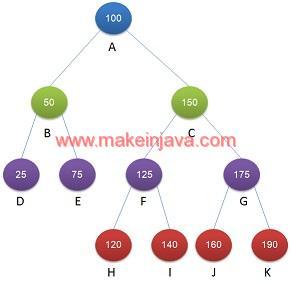
Example: find Kth smallest element in binary search tree.
- Traverse the binary tree using inorder tree traversal algorithm.
- The inOrder traversal of binary tree is as follows:
- Visit left child
- Visit current node or parent node
- Visit right child

The Inorder traversal of binary search tree is:
25 50 75 100 120 125 140 150 160 175 190
| K value | Output value |
|---|---|
| 1 | 25 |
| 3 | 75 |
| 5 | 120 |
| 8 | 150 |
Algorithm to find K Smallest Element in BST (DFS/recursive).
- Pass K representing the element (Kth smallest element in BST)
- Array representing the number of element visited [int arr[] = {0}]
- We have wrapped the integer to array
- Pass integer as array object.
- So that we can use its reference in recursive call
- In recursive call keeping track of this integer
- We have used it to compare with K
- Perform InOrder tree traversal (DFS traversal)
- Whenever we found arr[0] == K
- We found the Kth element
- Start returning from recursive call
- At the end of loop, we will get the K Smallest element in BST.
- Time Complexity: O(n)
Program – find K smallest element in binary search tree (recursive algorithm)
1.) KSmallestElement Class:
- KSmallestElement class performs Inorder traversal of binary search tree to find out Kth smallest element.
package org.learn.Question;

import org.learn.PrepareTree.Node;

public class KSmallestElement {
	public static Node kSmallestElement(Node root, int k, int[] iElement) {
		if(null == root) {
			return root;
		}

		Node left = kSmallestElement(root.left, k, iElement );
		if(null != left) {
			return left;
		}

		iElement[0] ++;
		if(iElement[0] == k) {
			return root;
		}
		return kSmallestElement(root.right,k, iElement);
	}

}
2.) App Class:
- We are creating the binary search tree in main method.
- We will invoke method of KSmallestElement class to find out Kth smallest element in a binary search.
package org.learn.Client;

import org.learn.PrepareTree.Node;
import org.learn.Question.KSmallestElement;

public class App {
    public static void main( String[] args) {
       //root level 0
       Node A = Node.createNode(100);
       //Level 1
       Node B = Node.createNode(50);
       Node C = Node.createNode(150);
       //Level 2
       Node D = Node.createNode(25);
       Node E = Node.createNode(75);
       Node F = Node.createNode(125);
       Node G = Node.createNode(175);
       //Level 3
       Node H = Node.createNode(120);
       Node I = Node.createNode(140);
       Node J = Node.createNode(160);
       Node K = Node.createNode(190);

       //connect Level 0 and 1
       A.left = B;
       A.right = C;
       //connect level 1 and level 2
       B.left = D;
       B.right = E;
       C.left = F;
       C.right = G;
       //Connect level 2 and level 3
       F.left = H;
       F.right = I;
       G.left = J;
       G.right = K;

       int arr[] = {0};
       int k = 3;
       Node element = KSmallestElement.kSmallestElement(A,k,arr);
       if(null != element)
    	   System.out.printf("Smallest element K =
                                   %d is %d ",k,element.data);
       else {
    	   System.out.printf("No element found for K = %d",k);
       }
       arr[0] = 0;
       k = 5;
       element = KSmallestElement.kSmallestElement(A,k,arr);
       if(null != element)
    	   System.out.printf("\nSmallest element K =
                                 %d is %d ",k,element.data);
       else {
    	   System.out.printf("No element found for K = %d",k);
       }
    }
}
3.) Node Class:
- Node class representing the nodes of a binary tree.
package org.learn.PrepareTree;

public class Node {
	public int data;
	public Node left;
	public Node right;

	public Node(int num) {
		this.data = num;
		this.left = null;
		this.right = null;
	}

	public Node() {
		this.left = null;
		this.right = null;
	}
	public static Node createNode(int number) {
		return new Node(number);
	}
}
Output – K smallest element in binary search tree (depth first search)
Smallest element K = 3 is 75
Smallest element K = 5 is 120
Download Code – K Smallest Element in Binary serach tree – DFS