

- Given a binary tree, calculate non-leaves having left & right child nodes in a binary tree.
- Count non leaf nodes having both children.
- We will iterate the binary tree using level order traversal or breadth first search (BFS) traversal.
- We have already discussed:
- Count non leaf nodes in a binary tree having one child (Either left child or right child).
- Count non leaf nodes in a binary tree (having one child or both children).
Examples: Count non leaf nodes in a binary tree
Example 1: Number of non leaf nodes in binary tree (left & right children).
Given a binary tree shown in Fig 1, calculate the number of non leaf nodes having left & right child nodes.
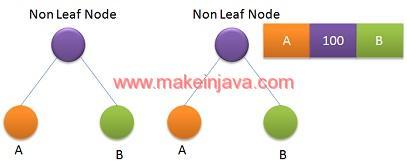
- Traverse the binary tree using level order traversal algorithm.
- At each node check the reference of left & right node.
- If current node have non null left & right node
- Increment the count of leaf nodes.
- Else, keep on traversing the binary tree.
- If current node have non null left & right node
- We will have following conditional statement to cater this case.
  if( node.left != null && node.right != null) {
    nNonLeaves++;
   }
Example 2: Count non leaf nodes having left & right child (Fig 2).
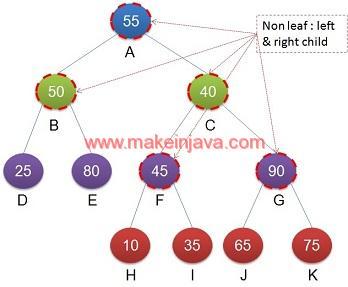
- Traverse binary tree using breadth first search.
- Declare a variable nLeaves = 0
- During iteration check, current node has both left & right child.
- nLeaves ++ (if nodes have both left & right child).
- At the end of iteration, we will number of non leaf nodes having left & right child node.
- Number of non leaf nodes of binary tree is 5.
Time complexity of algorithm is O(n).
Program – count non leaf nodes in a binary tree using java
1.) CountNonLeafTwoChildren class:
- CountNonLeafTwoChildren class is responsible to calculate the number of non leaf nodes in a binary tree.
package org.learn.Question;

import java.util.LinkedList;
import java.util.Queue;

public class CountNonLeafNodes {
	public static int countNonLeafNodes(Node root) {
		if (root == null) {
			System.out.println("Tree is empty");
			return -1;
		}
		int nNonLeaves = 0;
		Queue<Node> queue = new LinkedList<Node>();
		queue.offer(root);

		while (!queue.isEmpty()) {
			Node node = queue.poll();

			if (node.left != null && node.right != null) {
				nNonLeaves++;
			}
			if (node.left != null) {
				queue.offer(node.left);
			}
			if (node.right != null) {
				queue.offer(node.right);
			}
		}
		System.out.println("Number of non-leaf nodes : " + nNonLeaves);
		return nNonLeaves;
	}
}
2.) Node class:
- Node class represents the nodes of a binary tree.
 package org.learn.Question;

public class Node {
	public int data;
	public Node left;
	public Node right;

	public Node(int num) {
		this.data = num;
		this.left = null;
		this.right = null;
	}

	public Node() {
		this.left = null;
		this.right = null;
	}
	public static Node createNode(int number) {
		return new Node(number);
	}
}
3.) App Class:
- We are creating a binary tree in main method.
- We are calling CountNonLeafTwoChildren class, to calculate number of non leaf nodes using level order traversal.
package org.learn.Client;

import org.learn.Question.CountNonLeafNodes;
import org.learn.Question.Node;

public class App {
	public static void main(String[] args) {
		// root level 0
		Node A = Node.createNode(55);
		// Level 1
		Node B = Node.createNode(50);
		Node C = Node.createNode(40);
		// Level 2
		Node D = Node.createNode(25);
		Node E = Node.createNode(80);
		Node F = Node.createNode(45);
		Node G = Node.createNode(90);
		// Level 3
		Node H = Node.createNode(10);
		Node I = Node.createNode(35);
		Node J = Node.createNode(65);
		Node K = Node.createNode(75);

		// connect Level 0 and 1
		A.left = B;
		A.right = C;
		// connect level 1 and level 2
		B.left = D;
		B.right = E;
		C.left = F;
		C.right = G;
		// connect level 2 and level 3
		F.left = H;
		F.right = I;
		G.left = J;
		G.right = K;

		CountNonLeafNodes.countNonLeafNodes(A);
	}
}
Output – count non leaf nodes having left & right child nodes in java
Number of non-leaf nodes : 5
Download Code – Count Non Leaf nodes Binary Tree